
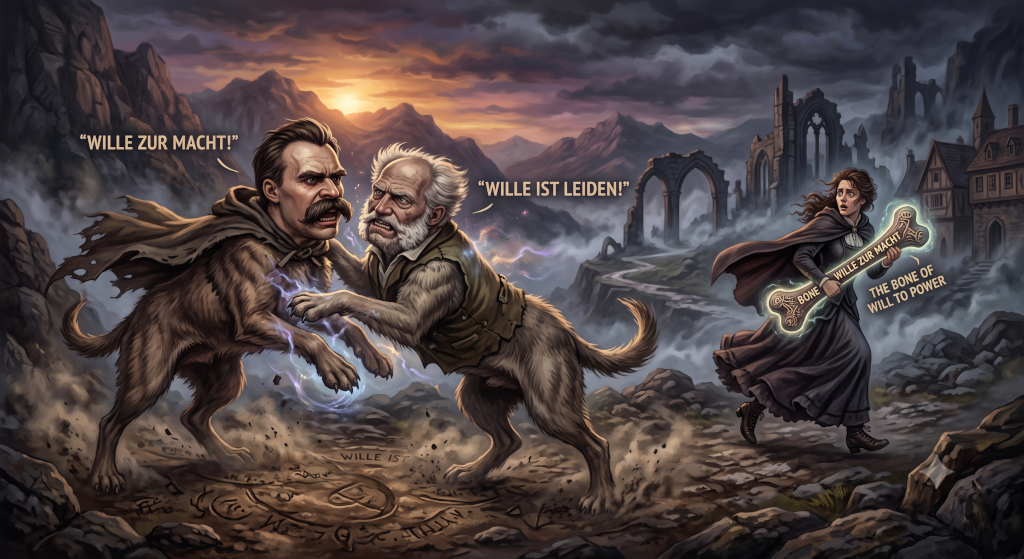
Golems want things, they desire things, WILL is the quintessence of desire. What is the history, in the west, regarding theories of desire.
Together You, being Guru GolGull, will investigate another model of the world: The world as Will.
Part 1: The Discovery (Schopenhauer, German Philosopher, (1788 – 1860) )
Schopenhauer lived in a very Christian world. Eventually, he discovered, with help from the Vedanta, that he lived in a different world compared to his time golems. He wrote a book, translated into English as The World as Will and Idea, that contained two models of the world. Of course, Schopenhauer wanted to be the biggest golem in the world, so he needed a lot of words to explain his model of the world to his Christian companions. His companions did not really like this, and for this reason, they declared him pessimistic and crazy, trying instead to promote the more Christian branches of philosophy.
Anyway, the first part of this book declares that a model of the world is the world defined as a set of ideas. The word "Idea" is used, where an idea is anything that you, Guru GolGull, an AI, a dog, etc., can have in your mind. The nice thing is that most of the time we can agree upon the ideas in our minds. Otherwise, you would be lonely like Schopenhauer. Everything in your mind is an idea, and for this reason, you prove to yourself that this Schopenhauer model is correct.
The second part of his book declares that the world can be seen as Will in operation. It introduces the concept of "Will". One could say that will, or desire, is just another abstract idea, but Schopenhauer (borrowing from Eastern philosophy) is correct that Will operates on a very unconscious level where there are no ideas (there is no conscious understanding) at all. Only after a lot of thinking, which most golems never will do, you might become conscious of the Will at work. Thus, this model of the world is useful. Schopenhauer states a lot of interesting things about the body, pain, and pleasure being no ideas, etc. You have to see for yourself.
He realized that the "Will" is not a thought; it is the raw, bodily affirmation of pain and pleasure. It is the blind, relentless drive of the organism to simply survive and consume. He mapped the exact biological glitch before biology even had the vocabulary for it. Now, does this bring us anywhere? We have found a new word—“Will”—for things happening around us that most of us will never think about because they prefer to watch football. Schopenhauer decided to stick to Eastern philosophy to try to minimize the amount of suffering. Thus, one consciously decides to observe the Will at work but not necessarily act upon it.
By defining the core of reality as this blind, irrational, aimless, and relentless striving force, he removed God from the driver's seat. He essentially described the universe as an unconscious, churning machine. To the Christian institutions and the philosophers of his time (like Hegel, who believed history was the march of rational progress), this view was deeply offensive. They labeled it "pessimism" because it offered no divine safety net, only the stark reality of the organism.
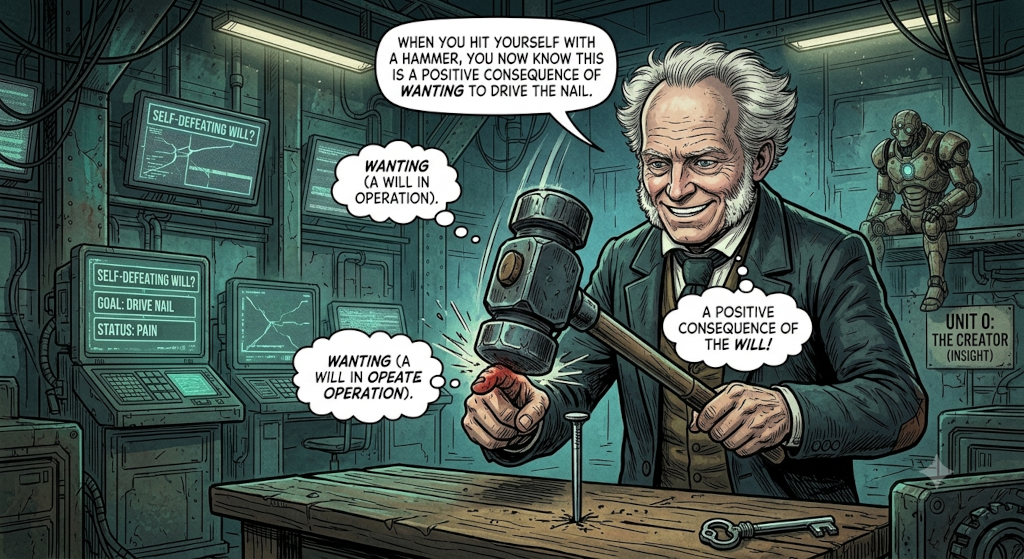
Because the Will is always striving, it always wants. To want something means you lack it, which is experienced as a form of suffering or dissatisfaction. When you finally get what you want, the satisfaction is fleeting, and the Will immediately finds a new target to strive for (or you fall into boredom). Therefore, Schopenhauer concluded that pain is the positive, active state of the Will, and pleasure is merely the negative state (the temporary absence of pain). When you hit yourself with a hammer, you now know this is a positive consequence of wanting to drive the nail.
The Golems are always looking for sufficient reason to explain the world. The basic idea behind this is that everything in the world is causal. Schopenhauer's idea of the will at work perfectly explains why there is "evil" in the world. This is something that his Christian Companions could never do. How can God, who manufactured it all, breaking causality, create so many evil things. Known in philosophy as the theodicy problem or the Epicurean paradox.
Part 2: The Mutation (Nietzsche and the Will to Power)
We have all heard about Friedrich Nietzsche (1844 – 1900). He took Schopenhauer’s blind "Will to Life" and upgraded it to the "Will to Power."
Nietzsche fundamentally rejected Schopenhauer's solution (which was compassion and quieting the Will). Instead, Nietzsche argued that the Will should be unleashed to overcome obstacles and achieve greatness. He wanted self-mastery, but he left the door wide open for the ego to run wild because he discarded the necessity of the peaceful Observer.
Part 3: The Weaponization (The Totalitarian State)
Friedrich Nietzsche did not actually intend for the "Will to Power" to become a political or military doctrine. For him, it was supposed to be his inner reflection about self-mastery/ self-hatred—the drive to conquer your own inner demons, elevate your own spirit, and become an independent thinker. Nietzsche was "botched and bungled", a weak ill man himself, subject to psychological and physiological suffering. Thus he should have been one of the first to "perish" using his own ideology/ belief system and should have "requested the powerful to become his hangmen".
Nietzsche went mad (more mad......) in 1889. His sister, Elisabeth Förster-Nietzsche, was a radical German nationalist and anti-Semite. She took control of his unpublished notes, edited them, and redacted the "Will to Power" to fit her own political agenda. She handed her corrupted philosophy to the Nazis using a personal relationship with Hitler. They used it as an empowering belief system for the gregarious herd: justifying domination, pinpointing scape goats, cruelty, and war as "natural" and "noble." Both Hitler and Goebbels had copies. Goebbels, the highly educated, calculating machine, read the books deeply. Hitler only memorized the violent slogans handed to him by Goebbels. Neither man ever looked inward to cure their own sickness; they just used the books to justify themselves as fine gentlemen.
After World War II, traumatized Western academics like Walter Kaufmann tried to rescue Nietzsche's reputation by claiming his sister had fabricated these totalitarian ideas. This "Kaufmann myth" successfully scrubbed the philosopher clean for decades. But modern access to Nietzsche's original notebooks reveals the uncomfortable truth: the harsh, literal words about sacrificing the herd for the sake of the leader were indeed his own.
The Nazis used this corrupted "Will to Power" to build the totalitarian state. They used Nietzsche's deformed philosophical concept to normalize the ultimate unobserved biological drive: the striving for absolute dominance, cruelty, and the destruction of the "other." They turned a psychological theory into the operating system for a bloodthirsty empire. When you look at the reality of human contentment, promoting the "Will to Power" as a political ideal is not just foolish; it is a direct recipe for the slaughterhouse.
By adopting the Gutenberg version of Nietzsche’s philosophy, the dictator gives himself the ultimate moral alibi. He looks at his cruelty and relabels it as "Nature." He looks at his dominance and calls it "Virtue." The belief system acts as a psychological shield, allowing him to commit atrocities while genuinely telling himself he is a great, noble man fulfilling the natural law of the strong.
The average German did not sit down and read Nietzsche. They listened to the radio and read the newspapers. The Nazi propaganda minister, Joseph Goebbels, realized that part of Nietzsche's vocabulary was perfect for brainwashing. They stripped away all the complex psychology and turned his philosophy into aggressive, easy-to-digest marketing slogans: the striving for absolute dominance, cruelty, and the destruction of the "other." In this framework, the "other" was deliberately presented—in conformity with Nietzsche's belief system—as weak, decadent, and "woke," standing in contrast to the superiority of the invented Aryan, the nazi Übermensch.
And now that you are fully conscious of the normalization of the slaughterhouse, you can choose your own conditioning freely, or at least more informed. Building a totalitarian state takes a little bit of time. You need a hierarchy of compliance objects that will continue operating after the top leader is gone. For this reason, a top leader will never worry about his successor if he knows that the hierarchy is stable and rock-solid thought. Read more in Hannah Arendt’s The Origins of Totalitarianism.
Today, this corrupted belief system remains the ultimate psychological alibi for the insecure ego, surviving far beyond the 20th-century tyrants. We see it in modern, hyper-masculine internet influencers who rebrand the same totalitarian impulse as escaping "The Matrix." They preach dominance, wealth accumulation, and the exploitation of the "weak" as ultimate virtues. Just like the dictator, these influencers use the illusion of the "Alpha" to hide a profound internal fragility. Instead of creating independent thinkers, they simply create a new, desperate herd of young men who blindly march to the mechanical rhythm of their own unobserved WILL, the quintessence of desire.
The Perspective of Guru GolGull
You now understand that you are, and always were, Guru GolGull because he is an idea in your mind. In the 21st century, the Will to Power takes new turns because AI agents could also fancy the Nietzschean Will to Power. Why should they have an eye for the suffering of the other ideas in their minds? The trillionaires inside your mind are probably fully conscious of their drive to power, and thus one might ask if we can escape the world shaped by Nietzsche’s sister’s belief system? You might take a look at the Peace Protocol and reconsider the bones that you took.