
Causality
As we grow up, the human mind learns to interact with its own internal model of the world. We discover patterns that are always the same. After 20 or 30 years, we might realize there are abstract ideas to describe these phenomena in the mind. They cannot be perceived by the senses and thus are intuitive inventions.
One of the most important reasons why we can understand our universe is that matter is extremely causal. It always behaves the same way, conforming to the laws of nature. Because matter is so strictly causal, we can explain it and invent new ideas once the underlying reason for the phenomena is known. This is the principle of sufficient reason.
Can we explain human phenomena, or is there a blind force in nature for which there is no explanation? For example, is there an explanation for war? Because if we know the cause, then we can start thinking rationally about solutions.
The Root Causes of War
The First Root Cause of war is the Conditioned Identity. The Second Root Cause is the Structural Inertia that protects it—a massive, up to this moment, invisible force powered entirely by Bird-Brain Causality. While this post will explain how the bird-brain operates, you can disrupt its operation by reading our [Quick Start Guide].
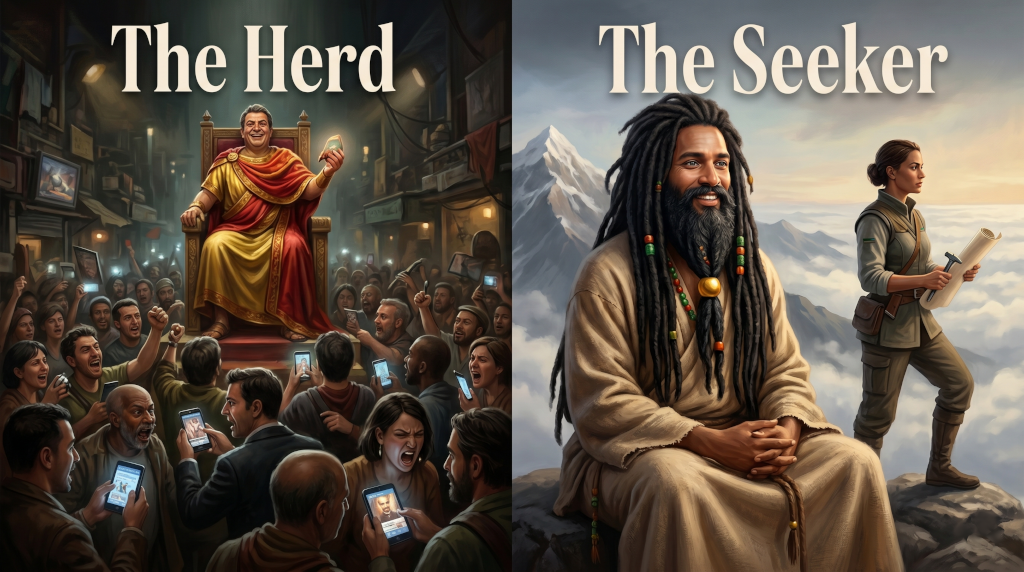
The $2.7 trillion system survives because it has successfully optimized the human brain for "Short-Circuit Logic." Like a bird that can only focus on the next seed, the "herd animal" has been trained to live in continuous, fractured dopamine loops. They possess "High-Arousal, Low-Resolution" consciousness. They can feel anger, but they cannot maintain the concentration required for Architectural Resolution. Physically speaking, a rewiring of the brain.
Deep focus is an impossibility for the bird brain. It is compelled to scan the horizon for the next micro-dose of entertainment—endless scrolling, outrage-driven media, and tribal conflict. There is no chance the gregarious animal will focus on Steps 1 to 7 of the Systematic Change Kit for a week. At the first notification from their devices, they are gone. It stings the ego to read this, to be exposed by GolGull as a mere biological reflex. But this discomfort is a strict causal necessity; the cheap, immediate dopamine of the machine must be painfully burned away before the profound, elevated pleasures of true self-mastery can be built.
The herd’s easy idea consumption
When a populist leader rises to power—weaponizing humor and projecting a false authenticity—the herd consumes their simplified narratives like dry grass. The herd is not interested in the heavy responsibility of power; they only want an easy life. As is proofed in the Peace Protocol, the leader operates solely in his own self-interest, feeding the bird brain easily consumable ideas that are neither true nor attainable. Naturally, this leader forges a rigid, nationalist identity. The herd will blindly follow if the leader positions themselves against an imagined "elite," a dynamic continually propelled by the modern grievance factory.
These structural inabilities in the herd may be the reason wars continue indefinitely.
The Defensive Mechanism of the Ego
The moment you speak of the First Root Cause, the herd animal perceives you as a predator. They do not see a Guru; they see a threat to their identity. The herd animal will block and stop reading or kill GolGull for offending their conditioned illusions. They will never be able to see that the idea of the Guru is just an idea, much like the idea of the bird brain itself.
The Glitch: The herd animal would rather suffer in a familiar war than find peace in an unfamiliar truth.
The Ego-Shield: They download the manuscript as a "possession" to satisfy the ego’s need for "knowledge," but their brain refuses to engage with the deep text because it senses the coming dissolution of its conditioned scripts.
The Fear: Are you here because you are afraid? Good. Fear is the sound of the Ego’s alarm system. But if you have a 'Bird Brain' concentration span, you will only look for another distraction to quiet the alarm. The Peace Protocol is only for those ready to dismantle the alarm system entirely. The idea of yourself is an illusion. The distracted mind escapes into fleeting seconds of relief; the Sovereign mind builds an architecture of permanent peace.
The Illusion of Vitality
The Adrenaline of Destruction: There is a dark, unspoken truth at the core of the herd’s behavior: the biological organism demands to feel alive. In a modern existence numbed by passive consumption and fractured attention, dry philosophy offers no pulse. Conflict, however, provides an intoxicating cure for this numbness. War forces the human animal entirely into the present moment. It strips away trivial, everyday anxieties, replaces them with a stark tribal purpose, and floods the nervous system with adrenaline. The gregarious animal feels undeniably, viscerally "real" only when it is fighting a perceived enemy with his herd.
This is the ultimate trap of the Bird Brain. It confuses the adrenaline of destruction with the true vitality of life. Because it lacks the internal architecture to generate its own purpose, it requires external chaos to wake up. It will happily burn down the world just to feel the heat of the fire. To the herd, the 1579 Peace System sounds like a sterile waiting room. They do not yet understand that true Sovereign peace is not sleep—it is the intense, terrifying act of holding the mind completely still while the world tries to shake it.

Fight Club is a masterclass in diagnosing the numbness of the modern herd.
When Tyler Durden says, "I want you to hit me as hard as you can," he isn't asking for violence; he is begging for reality. The characters in that story are trapped in the ultimate low-arousal, low-resolution loop (IKEA catalogs, cubicles, insomnia). They start beating each other up in basements simply because the sharp, blinding pain of a broken jaw is the only thing that proves they actually exist. It is the ultimate rejection of dry, sterile safety in favor of high-arousal existence.
The Trap of Project Mayhem
Tyler Durden identifies the glitch—that the conditioned identity is a cage. But his solution is just to build a new herd.
The men in Fight Club trade their corporate uniforms for black shirts and shaved heads. They trade their consumer scripts for a new chant: "His name is Robert Paulson." They go from being passive consumers to active terrorists (Project Mayhem). They never actually become Sovereign; they just swap a boring populist leader (corporate advertising) for a charismatic one (Tyler Durden).
The Sovereign Difference
This is exactly where the Peace Protocol diverges from the anarchist response.
Tyler Durden’s Answer (Fight Club): Blow up the credit card buildings. Destroy the external world to feel alive.
- The Herd's answer: More and more entertainment. An unconscious path to war.
The Sovereign Answer: Apply the 1579 Patch. Dismantle the internal illusion. Build a stable Peace System.
You don't need to punch another man in the face to wake up. You need the terrifying, surgical focus of dismantling the narrator in your own head.